REVIEW · KRAKOW
Krakow Jewish District and Ghetto Guided Tour in a Small Group
Book on Viator →Operated by Krzysztof Blaszczyk Hussar Travel · Bookable on Viator
Krakow’s Jewish story comes in clear stops. This guided walk helps you check off the big names and places tied to Jewish life in Kazimierz and the Krakow Ghetto without wandering around guessing. I like the small group size (max 10) because it keeps the pace human and makes it easier to ask questions, not just listen. You’ll also get a guided tour of the key sites with commentary that ties locations together fast.
The one thing to plan for is time spent at popular indoor spots: a past guest said the lines can snake around the block, so booking ahead can save you stress. Some stops are viewed from outside, so if you were hoping for wall-to-wall interior access, set expectations early.
In This Review
- Key things I’d circle before you go
- A 2-hour route that saves you from wandering (and missing the point)
- Starting at Szeroka Street: where the Jewish Quarter feeling begins fast
- Remuh and the Old Synagogue: outside views that still tell you a lot
- Wolf Popper and the Jan Karski statue: community, responsibility, testimony
- Plac Nowy: the market square where trade shaped community life
- JCC Krakow: seeing continuity instead of only stopping at the past
- Eagle Pharmacy and the ghetto streetscape: where place becomes meaning
- Plac Bohaterów Getta: the main place of the Krakow Ghetto
- Ghetto Wall Fragment: what’s left, and why that matters
- Price and value: is $60.21 worth your time?
- What to expect from the small-group format (and why it feels different)
- Who this tour suits best—and who may want a different style
- Should you book this Krakow Jewish District and Ghetto tour?
- FAQ
- How long is the tour?
- What’s the group size?
- Is the tour offered in English?
- Where does the tour start and end?
- Are admission tickets included?
- What’s the main route area covered?
- Do I get a mobile ticket?
- What’s the cancellation policy?
- Is everyone able to participate?
Key things I’d circle before you go
- Small group cap of 10 keeps the experience focused and easy to follow
- English-language guide means you’re not piecing context together on your own
- Szeroka Street to Plac Bohaterów Getta covers both Kazimierz and ghetto landmarks
- Major names in one route, including Remuh, Wolf Popper, and Jan Karski
- Short, structured timing keeps the tour efficient at about 2 hours
- Free admission listed at multiple stops, so you’re not hit with surprise entry fees
A 2-hour route that saves you from wandering (and missing the point)
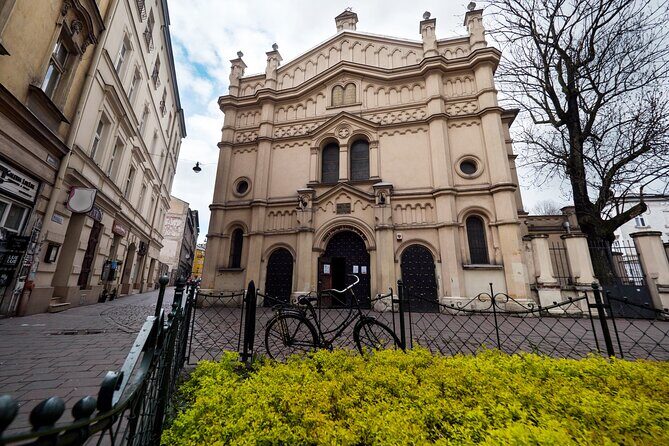
If you’re short on time but want the real context for Krakow’s Jewish districts, this is a smart way to do it. The walk is designed to connect the dots: where community life gathered, where synagogues stood, and how the ghetto area carved a different reality into the city. You’re not expected to know the geography ahead of time, and you won’t be left to figure it out alone.
What makes this format work for most people is the structure. It moves in small segments, and each stop is timed tightly (many are just a few minutes). That keeps energy up, too. In a place with heavy subject matter, you want momentum, not a long, aimless slog where your brain goes numb.
Also, at $60.21 for roughly 2 hours with a guide, it’s not bargain-basement cheap. But you are paying for efficiency: a human guide to interpret what you’re seeing, a small group cap, and an easy route that takes you across both Kazimierz and ghetto landmarks. If you’ve ever tried to do this on your own and ended up reading three maps at once, you’ll understand why that value matters.
You can also read our reviews of more guided tours in Krakow
Starting at Szeroka Street: where the Jewish Quarter feeling begins fast
The tour starts at Szeroka 6—a good choice because it gets you into the oldest fabric of the Jewish Quarter right away. This isn’t a random meeting point. Szeroka Street helps set the tone: it’s the kind of street where you can sense how people once moved through the neighborhood day to day, not just as a “sight.”
From the start, the guide’s role is to keep you oriented. That sounds basic, but in Krakow, that’s half the battle. Streets can look similar, and it’s easy to wander past what matters. Here, you’re guided from site to site so you’re constantly anchoring what you see to a bigger story.
If you like walking tours, you’ll enjoy the pacing. It’s brisk enough to keep things efficient, but not so fast that you’re sprinting for your own context.
Remuh and the Old Synagogue: outside views that still tell you a lot
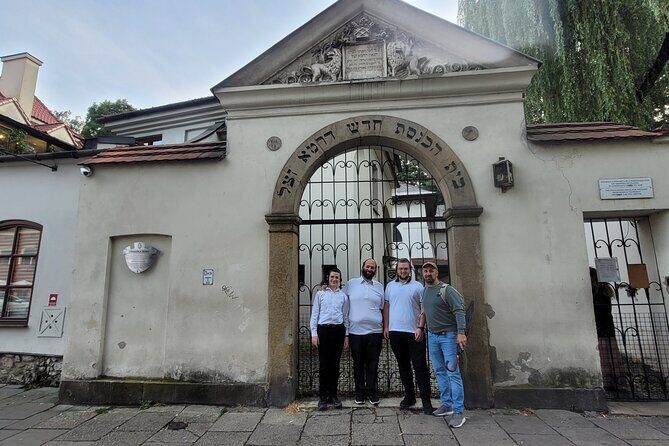
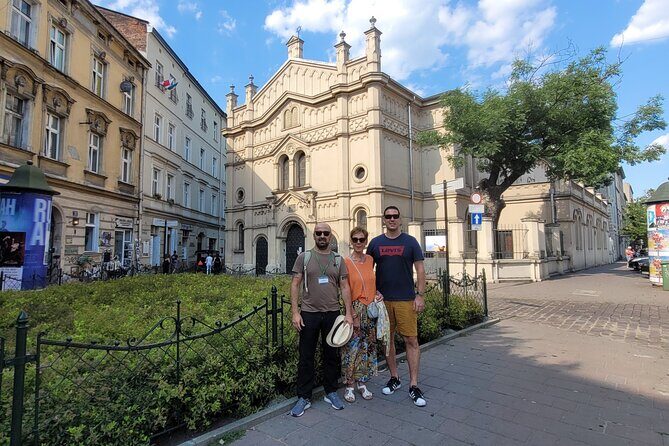
One of the stops is Remuh Synagogue, seen from outside for about 15 minutes. Another is the Old Synagogue, also from outside. Even without entering, these exterior stops can be educational because synagogues are landmarks in multiple ways: architectural, communal, and geographic.
Here’s what I think you should watch for on a quick outside viewing:
- Notice how the buildings sit in the neighborhood rather than floating alone.
- Pay attention to any visible features the guide points out, because those details help you connect form to function.
- Listen for what makes each synagogue historically distinct—especially the way Jewish communities were organized and how different places served different needs.
The drawback is straightforward: you’re not going inside at these particular moments. If you’re the type who learns best by reading every plaque and stepping into every room, you may wish you had extra time for independent museum visits after the tour.
That said, if your goal is orientation and context, an outside stop works. It’s often the right compromise for a two-hour route that includes both Kazimierz and the ghetto area.
Wolf Popper and the Jan Karski statue: community, responsibility, testimony
Next up you’ll reach Wolf Popper Synagogue, also a quick stop (about five minutes). Even when the timing is short, this kind of stop is valuable because it prevents the tour from becoming only “important-looking buildings.” A good guide uses these moments to explain why the place mattered to everyday Jewish life and religious practice.
Then comes one of the more powerful waypoints: a statue of Jan Karski, the man who tried to stop the Holocaust. This moment shifts the tour from place-based history into individual action. Statues are easy to skim, but with the guide commentary, it becomes a pivot point. You’re not just looking at the ghetto’s geography anymore—you’re hearing about moral pressure, risk, and the problem of being ignored.
There’s another synagogue stop set in this segment (a 19th-century synagogue viewed from outside), followed by the High Synagogue, also viewed from outside. Together, these exterior views help you understand that Jewish religious life wasn’t one single style or era. It changed over time, and the buildings reflect that.
Plac Nowy: the market square where trade shaped community life
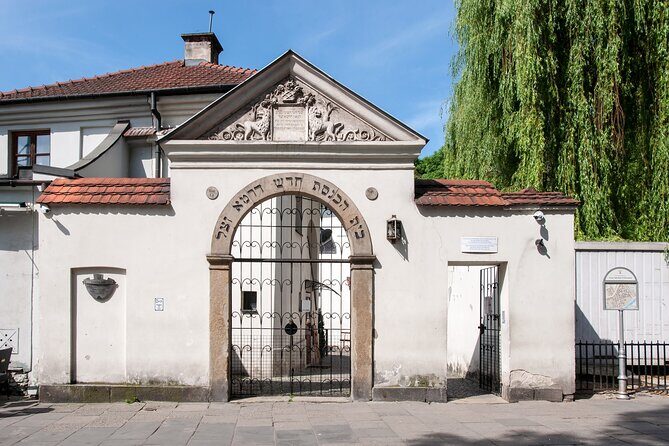
One of the clearest “why this location mattered” stops is Market Square, Plac Nowy. It’s timed at about 10 minutes and described as a center for trade for the Jewish community in centuries past.
Why I like this stop: it nudges you away from thinking of the Jewish Quarter as only religious buildings. Markets are where daily life happened—where people interacted, where supplies moved, where money and relationships got tangled into the real workings of a neighborhood.
If you’re wondering what to focus on, it’s simple: use the guide’s framing to imagine movement and exchange. Even if you can’t time-travel, this mental shift helps the whole walk click into place.
JCC Krakow: seeing continuity instead of only stopping at the past
The tour also includes a stop at JCC Krakow (about five minutes). In a route that otherwise centers on synagogues and ghetto memory, this is a useful counterweight. It’s not a “forget history” moment. It’s a reminder that communities are not only ruins and memorial plaques; they have present-day institutions and responsibilities.
Because the time is short, you won’t get a long briefing here. But the guided context can make you notice the difference between:
- Places that mainly hold memory, and
- Places that still function in public life
For many people, that contrast is what makes the walk feel complete rather than one-note.
Eagle Pharmacy and the ghetto streetscape: where place becomes meaning
When you reach the Eagle Pharmacy in the Krakow Ghetto area (viewed from outside for about 10 minutes), the tone of the tour changes. This is where the route stops being “Kazimierz sights” and becomes “ghetto landmarks.”
Pharmacy stops can sound ordinary at first—until you remember what kind of life the ghetto forced people into, and how shops and services still mattered even under extreme restrictions. The value here is the guide’s ability to connect the physical location to what it represented.
Again, you’re outside. So your job as a visitor is to keep listening. Let the guide explain what makes this place a marker of the ghetto’s reality, rather than treating it like a photo stop.
Plac Bohaterów Getta: the main place of the Krakow Ghetto
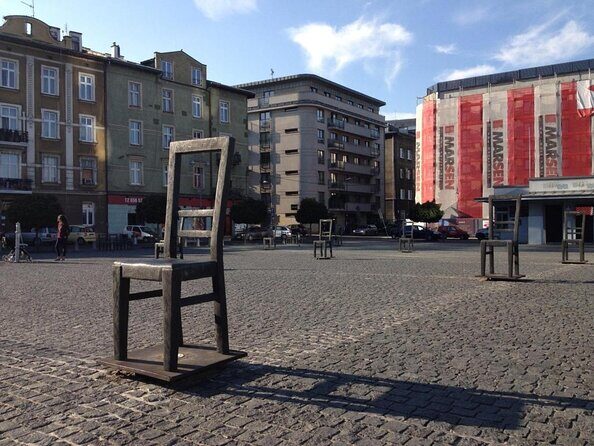
Next comes Plac Bohaterów Getta—about 10 minutes—listed as the main place of the ghetto. This is the emotional gravity center of the walk, and it matters that it’s framed clearly by the guide.
At this stage, I’d suggest you slow down a little, even if the tour schedule doesn’t. Read what you can, look around you, and let the guide’s commentary set the scene before you start snapping photos.
If you only do one thing well on this stop, it’s to stay present. In places tied to atrocity, the tour’s timing can otherwise feel like it’s moving too fast. The best thing you can do is listen carefully and give the moment space.
Ghetto Wall Fragment: what’s left, and why that matters
The tour ends with a visit to a Ghetto Wall Fragment (about five minutes). This short stop is powerful because it’s literal: remnants of wall, not just stories on a screen.
I like that it’s brief rather than long. After the emotional weight of Plac Bohaterów Getta, a tight final segment can feel like a controlled landing. You’re left with a visual anchor you can carry away.
And if you’re the type who wants to understand the scale of historic boundaries, pay attention to what the guide says about the fragment’s location and what it represents. Even small remnants can communicate big ideas when explained well.
Price and value: is $60.21 worth your time?
Let’s talk value plainly. At $60.21 for about 2 hours, you’re paying for:
- A guide who connects sites into a coherent route
- A small group max of 10, which makes the tour feel manageable
- An English-language experience
- A structured walk that covers Kazimierz and ghetto landmarks in one shot
- A tour format that lists multiple stops with admission ticket free (and several stops viewed from outside)
Whether it’s a good deal for you depends on how you plan to spend your Krakow time. If you’re staying in town and want to get oriented quickly, it’s strong value. If you already love self-guided history work and don’t need someone to steer the narrative, you might choose to build your own route later.
But the practical advantage is real: this tour reduces the “I’m not sure what I’m looking at” problem. And in a city where walking routes can be confusing, that’s not fluff—it’s time saved and confusion avoided.
One more note from prior feedback: some popular indoor stops can have long lines, so booking ahead is smart. Even if your tour views certain sites from outside, you may still be passing through areas where queues form.
What to expect from the small-group format (and why it feels different)
A group capped at 10 is a big deal on tours like this. You’re close enough to hear commentary clearly, and it’s easier for the guide to adjust the pace if people have questions. You also get a sense of who’s in the group—there’s less “everyone is scattered” energy.
The tour is also designed around short stops with clear themes. That keeps it from becoming a slow procession of random buildings. Each segment has a job: synagogues for place and identity, Plac Nowy for trade and daily life, JCC Krakow for continuity, then ghetto sites for memory and geography.
If you’re someone who likes to ask questions, this format gives you better chances than a large group bus tour.
Who this tour suits best—and who may want a different style
This guided walk is a great fit if you:
- Want a fast, organized overview of Krakow’s Jewish Quarter and ghetto landmarks
- Prefer a guide to tie places to meaning
- Like smaller groups and don’t want to fight crowds
- Are okay with seeing some key sites from the outside as part of a tight schedule
You might consider a different approach if you:
- Want long, in-depth museum-style time in multiple interiors
- Need a slower pace with more breaks
- Are hoping for a deep focus on only one area (Kazimierz or the ghetto) rather than both
Should you book this Krakow Jewish District and Ghetto tour?
I’d book it if you want a guided route that covers the essential geography without leaving you lost. The two-hour timing is honest and practical, the small group size keeps the walk manageable, and the site selection gives you both community life and ghetto landmarks in one flow.
Book it especially if you know you’ll be traveling with limited time in Krakow and you don’t want to gamble on finding context on your own. The one caution is lines at popular indoor stops—so if you care about entering specific places, plan to keep some extra time or be ready for queues.
If you want a well-led orientation walk that respects the subject without turning it into a confusing maze, this is a solid choice.
FAQ
How long is the tour?
The tour runs about 2 hours.
What’s the group size?
The tour is a small group with a maximum of 10 travelers.
Is the tour offered in English?
Yes, it’s offered in English.
Where does the tour start and end?
It starts at Szeroka 6, Kraków and ends at Plac Bohaterów Getta, Square of Ghettos Heroes.
Are admission tickets included?
The tour lists admission as ticket-free for several stops, but the only item explicitly included is the tour guide service.
What’s the main route area covered?
You’ll visit key sites tied to Krakow’s Jewish Quarter and then move through Krakow Ghetto landmarks.
Do I get a mobile ticket?
Yes, the tour includes a mobile ticket.
What’s the cancellation policy?
Cancellation is free up to 24 hours in advance for a full refund. After that cutoff, you won’t get a refund.
Is everyone able to participate?
The information says most travelers can participate.