REVIEW · KRAKOW
Kazimierz, Jewish Ghetto, Schindler’s List story – Golf Cart Tour
Book on Viator →Operated by See Cracow Tours - wycieczki melexem, zwiedzanie Krakowa · Bookable on Viator
Kazimierz tells its story fast. A golf cart tour lets you cover a lot of ground in a short hour and still stop for the key sights. I like how this route blends Jewish Kazimierz landmarks with the Catholic side, so the city’s layers make sense right away. The included photo stops make it easier to capture the places you’ll want to study later.
What I really liked most is the short, purposeful stops—Szeroka Street, Corpus Christi Church, and the ghetto memorial squares—so you don’t end up sprinting or second-guessing where to stand. I also like that the tour comes with English speaking guidance plus audio in 28 languages, which helps if you’re traveling with mixed comfort levels or just want more detail on demand.
One possible drawback: because the ride is about an hour and the max group size is 12, this is built for orientation, not deep, on-foot wandering. If you want lots of time to get out and explore at every stop, you may feel a bit rushed.
In This Review
- Key things to know before you go
- Kazimierz in one hour: why this buggy tour works
- Starting point at Plac Jana Matejki 3: getting oriented fast
- Szeroka Street and the synagogue area: where details matter
- Corpus Christi Church and the Kazimierz split you can actually see
- Ghetto Heroes Square, Eagle Pharmacy, and the wall fragment
- Schindler’s factory area: what you’ll see before the museum
- Photo stops and timing: how to get the best results
- Price and what you’re actually paying for
- The guide factor: when the experience clicks
- Who should book this Kazimierz and ghetto buggy tour
- Should you book? My straight call
- FAQ
- How long is the Kazimierz, Jewish Ghetto, and Schindler’s List story golf cart tour?
- How much does the tour cost?
- Is the tour offered in English?
- What stops will I see during the tour?
- Is the Schindler’s Factory Museum ticket included?
- Where do I meet for the tour?
- Where does the tour end?
- What if it rains?
- How big is the group?
Key things to know before you go
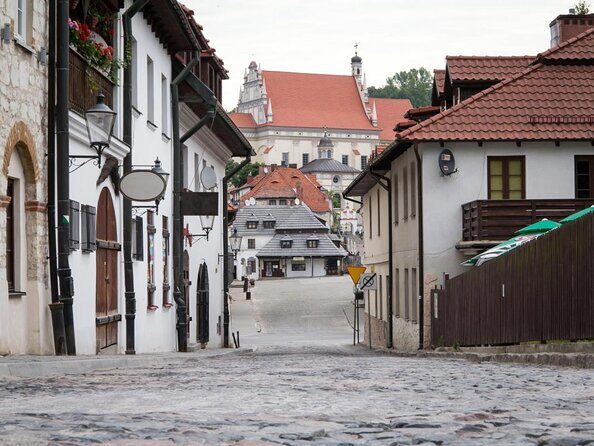
- Golf cart format = quick orientation through Kazimierz and the former ghetto area
- Photo stops are built in, including major streets and memorial points
- English guidance plus audio in 28 languages keeps the information flowing
- Rainproof, heated vehicle helps you keep going on wet Krakow days
- Tour ends at Schindler’s Enamel Factory, so you can continue to the museum on your own
- Small group size (max 12) keeps the experience manageable
Kazimierz in one hour: why this buggy tour works
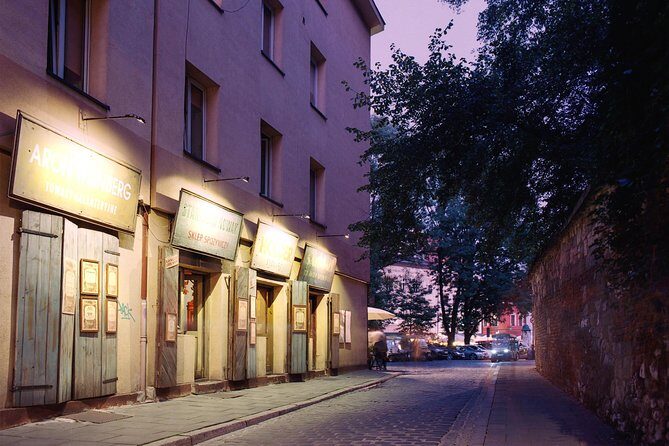
Kazimierz moves in layers. You’ve got centuries of Jewish life, wartime terror, and then the way Krakow rebuilt and reinterpreted those spaces after World War II. Walking that all out can take longer than you think, especially if weather turns or you’re juggling museum plans later in the day.
That’s where a golf cart tour earns its keep. You get a guided route that hits the areas most people come to understand: the former Jewish Quarter, the ghetto area, and then key points that show how the neighborhood connects to the broader city. It’s not just sightseeing from a sidewalk. It’s more like a guided “map in motion,” with short stops that let you actually look, photograph, and absorb.
And yes, it’s practical. The vehicle has heating and a rainproof cover, which matters in Krakow. On chilly or wet days, that alone can save your mood.
You can also read our reviews of more tours and experiences in Krakow.
Starting point at Plac Jana Matejki 3: getting oriented fast
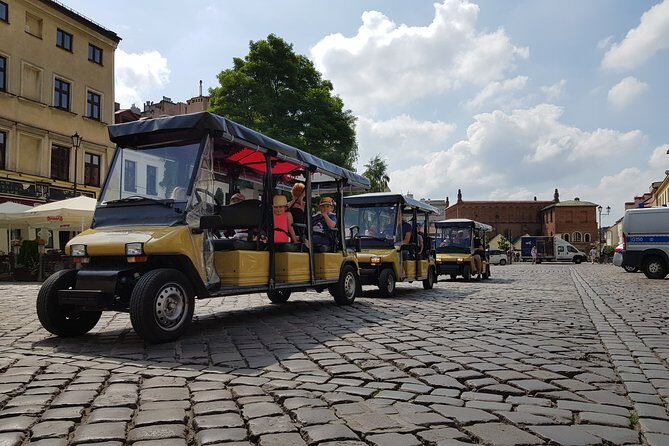
Your tour pickup starts at plac Jana Matejki 3. From a planning point of view, I like that it’s near public transportation, because it means you’re not stuck in the middle of nowhere waiting for a private taxi.
Once you’re on the buggy, the rhythm is simple: ride a bit, stop for a photo, then ride again. This creates a clean flow through two neighborhoods that can feel confusing if you arrive on your own without a plan. The stops also help you build a mental sketch of the area: streets, synagogues, memorial points, and the broader “Kazimierz split” you’ll hear about as you go.
The tour is about one hour. That sounds short until you realize you’re not trying to replace the major museums—you’re getting the bones of the story first.
Szeroka Street and the synagogue area: where details matter
One of your first must-see photo moments is Szeroka Street. This street is famous because it’s tied directly to Jewish community life and the cluster of important synagogues nearby. Even if you’re not going inside every building, seeing the street layout gives you context for why these places were where they were.
In the synagogue/old quarter section, you’ll pass or stop around a group of historic sites, including:
- Old Synagogue
- Rhemu Synagogue
- Issaak Synagogue
- Tempel Synagogue
- Old Jewish cemeteries
- Places connected to Helena Rubinstein
- New Square
What I find useful about this part is that it’s not presented as a checklist of random stops. It’s meant to show how a community is anchored: by places of worship, learning, and identity, plus nearby streets that held daily life.
If you’re the type who likes to photograph architecture, do it here. This is the stretch where small visual cues—signage, street geometry, and building placement—help you later when you look up more details.
Corpus Christi Church and the Kazimierz split you can actually see
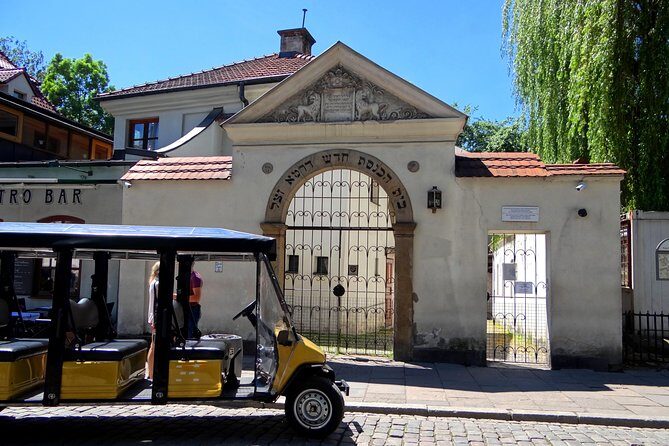
Another key stop is Corpus Christi Church (Kosciol Bozego Ciala). You’ll also see the Catholic side elements of Kazimierz, including points like the town hall and other neighborhood landmarks as the route transitions.
This is an important part of understanding Krakow. Kazimierz isn’t only Jewish in the historical sense; it’s also a functioning part of the city with Catholic landmarks and civic buildings. Seeing both sides in the same tour helps you avoid a common mistake: treating the ghetto and Jewish quarter as if they were isolated from the rest of Krakow.
This isn’t a long stop—think about minutes, not hours. But it’s long enough to orient your brain: you see where Jewish spaces were, and you also see where the city’s other institutions were, too.
For me, it turns the story from an abstract timeline into geography you can remember.
Ghetto Heroes Square, Eagle Pharmacy, and the wall fragment
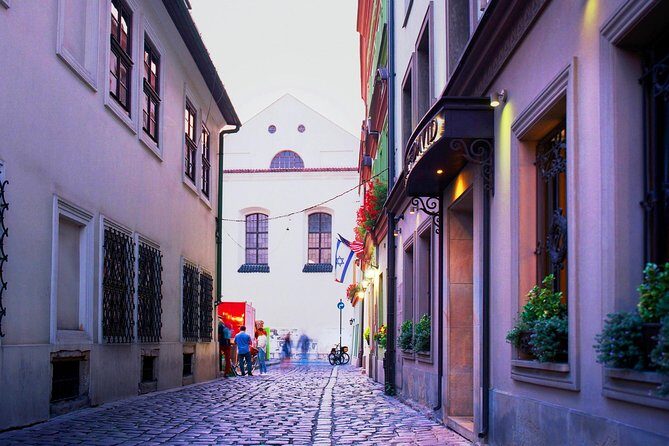
Now the tour turns heavier. You’ll move through the ghetto area highlights such as:
- Ghetto Heroes Square (Plac Bohaterow Getta)
- Eagle Pharmacy
- A fragment of the ghetto wall
Even though the stops are short, these points are chosen for a reason. Squares and street-level landmarks are often where you’ll feel the city’s wartime reality the most, because they’re tied to real locations that still exist in the present.
The Eagle Pharmacy stop is one of those places that helps you understand how the ghetto experience was intertwined with surrounding streets and services. You get a “place-to-story” connection instead of only hearing the story in general terms.
For the ghetto wall fragment, think of it as a physical anchor. It’s not just a memorial idea. It’s material evidence that the boundary existed.
This part of the tour can feel emotionally intense. That’s normal. If you need a moment to breathe, do it on the buggy while you roll to the next stop rather than forcing yourself to keep staring.
Schindler’s factory area: what you’ll see before the museum
The tour ends at Oskar Schindler’s Enamel Factory (Lipowa 4), and you pass or stop at Fabryka Emalia Oskara Schindlera. This is the real Schindler’s factory building area where the museum sits.
Important detail: your tour does not include the Schindler’s Factory Museum ticket. But you do get value because the tour brings you to the exact site, and you’ll leave with context so your museum visit isn’t just background noise.
If your schedule allows, this is a strong two-step plan:
1) Take this hour-long buggy tour to get oriented and see the key locations.
2) Continue at Schindler’s factory museum at your own pace.
That way, the tour sets the scene, and the museum lets you slow down where you want.
Also, since the tour finishes in front of the factory, you don’t waste time backtracking.
Photo stops and timing: how to get the best results
This tour is built around short stops for pictures. That’s great for getting the “need-to-know” visuals, but it also means your best results come from a simple mindset: don’t try to do everything in one go.
Here’s what helps:
- Plan to take photos early at each stop, before you start reading signs or listening to the commentary.
- If your language skill is limited, lean on the audio in 28 languages to catch details without missing key points.
- Keep an eye on the sequence. Because the ride is compact, the order of stops matters for how the story connects.
There’s one more practical note: the vehicle is designed to move people efficiently, but that also means it’s not set up like a walking tour where you can linger for long chats or deep sketching sessions.
If you want both—orientation plus time to wander—do the buggy tour first. Then pick one or two areas you want to explore further on foot afterward.
Price and what you’re actually paying for
At about $26.41 per person for roughly an hour, this tour is priced for value in the “orientation package” category.
You’re paying for:
- An English speaking driver
- Short, structured stops that keep you from missing major points
- Photo-friendly timing
- A small group cap (max 12)
- A ride that stays comfortable thanks to the heated, rainproof vehicle
- Audio commentary in 28 languages, so the information doesn’t depend only on what you catch live
What you’re not paying for is the museum entry ticket at Schindler’s factory. That’s separate. But since the tour ends at the factory, you can still build a clean museum day without extra logistics.
If you’ve only got limited time in Krakow and you want your bearings fast, this price can make sense. If you’re the type who wants to spend most of the time out on the ground at every stop, you might get more satisfaction with a longer walking-focused tour or a museum-first strategy.
The guide factor: when the experience clicks
This kind of tour lives or dies by delivery. A strong guide can make short stops feel meaningful, and the route’s emotional weight can land with respect.
Some of the most positive feedback I’ve seen connected the experience to guides who were energetic, respectful, and willing to explain why certain places matter. One guide name that stands out in the comments is Valentino—credited for both knowledge and care, with stops that felt thoughtful rather than rushed.
On the other hand, a less perfect version of this experience can happen if the group is tiny and the stops don’t allow you to get out as much as you want. There can also be moments where you might struggle to catch everything if the pace or volume isn’t ideal. The good news is that the audio option helps as a backup.
My advice: if you care about hearing clearly, position yourself where you can hear the driver well from your seat.
Who should book this Kazimierz and ghetto buggy tour
I’d book this if you:
- want a fast overview of Kazimierz and the former ghetto area
- like photo stops and a guided route more than hunting for details on your own
- are traveling in mixed-language comfort levels (audio in 28 languages helps)
- need something that works even when the weather is poor
I’d rethink it if you:
- expect a long, stop-and-stroll walking experience
- want to spend lots of time outside each site
- hate short tours that move you along on a tight timeline
For many people, the sweet spot is exactly what this tour offers: get your bearings and understand the geography of the story, then choose one or two places to go deeper.
Should you book? My straight call
If your priority is orientation in Kazimierz and the ghetto area—plus a smooth finish at Schindler’s factory—this is an easy yes. The format is efficient, the stops are purposeful, and the weather-proof vehicle makes it more reliable than many outdoor-only options.
Book it if you want an hour that helps you plan the rest of your Krakow day. Skip it if you want a long, exploratory walking tour where you can linger at every location.
Either way, do yourself a favor: treat the buggy ride as your “map first” step. Then use your extra time at Schindler’s factory museum and any one or two Kazimierz streets you want to explore more slowly on foot.
FAQ
How long is the Kazimierz, Jewish Ghetto, and Schindler’s List story golf cart tour?
The tour lasts about 1 hour.
How much does the tour cost?
The price is listed as $26.41 per person.
Is the tour offered in English?
Yes. It is offered in English, and it includes an English speaking driver.
What stops will I see during the tour?
You will see major Kazimierz and ghetto area points, including Szeroka Street, Corpus Christi Church, Ghetto Heroes Square (Plac Bohaterow Getta), the Eagle Pharmacy, a fragment of the ghetto wall, and the Schindler’s factory area (Fabryka Emalia Oskara Schindlera).
Is the Schindler’s Factory Museum ticket included?
No. The museum ticket is not included. The tour ends in front of the factory, so you can visit it separately.
Where do I meet for the tour?
The start meeting point is plac Jana Matejki 3, 31-157 Kraków, Poland.
Where does the tour end?
The tour ends in front of Schindler’s Factory at Oskar Schindler’s Enamel Factory, Lipowa 4, 30-702 Kraków, Poland.
What if it rains?
The vehicle has a rainproof cover and heating, so the tour is designed to keep going in bad weather.
How big is the group?
The tour has a maximum of 12 travelers.