REVIEW · KRAKOW
Electric Scooter Tours Kraków
Book on Viator →Operated by eScooters Tours · Bookable on Viator
Want Krakow without the tired feet? This electric scooter tour is a smart way to cover a lot of ground in a short time, with a guide steering you past major sights while you cruise. I like that helmets and warm gloves come with the scooters (and you get a practice run), and I like how the route threads together big hits like Wawel Royal Castle viewpoints and Krakow’s historic districts without you having to plan every turn.
One real consideration: the tour requires good weather, so if rain or messy conditions move in, you’ll want to stay flexible and expect an adjustment or refund options.
Key highlights worth your attention
- Easy start with helmet, gloves, and a practice ride so you’re not learning on busy streets
- A fast route through Old Town and Kazimierz/Podgórze so you see more than a standard walk
- Wawel viewpoints plus Krakow legends, including the Dragon stop
- World War II history stops tied to the ghetto areas and Schindler’s story
- A local snack included right at the beginning, plus plenty of food tips
- Private tour format, just your group, in English
In This Review
- Getting Oriented at the Meeting Point on Librowszczyzna
- Helmets, Warm Gloves, and the Local Snack Setup
- The Scooter Tour Rhythm: Short Stops, Big Coverage
- Barbican: How Krakow Protected Itself
- St. Florian’s Gate: A Wall Fragment With a Message
- Collegium Maius and Planty Park: Old University Energy
- Rynek Główny Central Square: Legends, Layout, and Local Lore
- St. Peter and St. Paul: A Church Stop That Doesn’t Feel Like a Checkbox
- Wawel Royal Castle Viewpoint by the Vistula
- Wawel Dragon: Legend You Can Spot Instantly
- Father Bernatek Footbridge and the Ghetto Story
- Krakus Mound: A Real Viewpoint Break
- Plac Bohaterów Getta and the WWII Details
- Remains of the Ghetto Wall: Seeing What Survived
- Schindler’s Enamel Factory Area: The War-Time Thread Continues
- Old Synagogue: The Before-War Community
- Kazimierz Market Square and Zapiekanki Options
- Price and Value: Why This Costs What It Costs
- Who This Tour Fits Best (and Who Might Want Another Option)
- What the Best Guides Add to Your Day
- Rain, Rebooking, and Staying Flexible
- Should You Book the Electric Scooter Tour in Krakow?
- FAQ
- How long is the electric scooter tour in Krakow?
- What is the meeting point for the tour?
- What time does the tour start?
- What is the price per person?
- What’s included with the scooter rental?
- Do I need to bring equipment?
- Is the tour offered in English?
- What is the minimum age?
- Is this tour private?
- What weather does the tour require?
Getting Oriented at the Meeting Point on Librowszczyzna
The tour starts at Librowszczyzna 4, 31-030 Kraków, and it runs from a set start time of 10:30 am, usually lasting about 3 hours. You’ll head back to the meeting point at the end, so you don’t need to figure out anything complicated on your own.
When you arrive, the first thing you’ll notice is how much of the trip is built around reducing stress. You’re greeted at the office, briefed on scooter use and health and safety, then you do a practice go. That matters. Many scooter tours either skip that step or rush it, and Krakow’s center has plenty of pedestrians and narrow lanes. Here, the idea is: learn the basics first, then enjoy the ride.
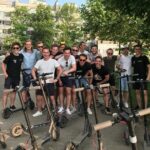
Also, it’s in English and you get a mobile ticket, which keeps the day simple. The tour is private, meaning it’s only your group. That typically makes questions easier and keeps the pacing more natural.
Finally, the group minimum is 12 years old, so if you’re traveling with younger kids, you’ll need another plan.
Helmets, Warm Gloves, and the Local Snack Setup
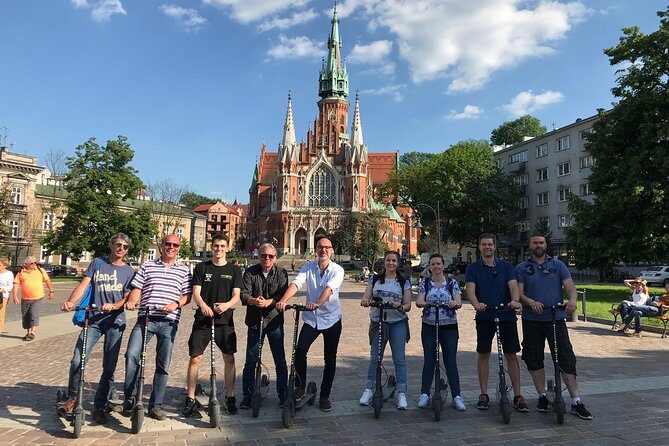
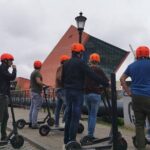
Before the city sightseeing starts, you get bundled up like someone planned ahead for real weather. You receive helmets, and on colder days you get warm gloves. That small detail can change the whole experience. If you’ve ever done a morning walk tour in Krakow when the wind bites, you know how quickly your hands can go numb.
You also get a free obwarzanek, a traditional Krakow snack. It’s not some afterthought. It’s timed early enough that you’re not dealing with hunger while you’re still learning the scooter. For a 3-hour ride, that snack is a practical win.
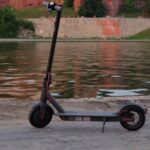
And yes, you’re covered for the scooter itself. Helmet and scooter rental are included, which is part of why the price feels more fair than a “guided walk only” option.
You can also read our reviews of more tours and experiences in Krakow


The Scooter Tour Rhythm: Short Stops, Big Coverage
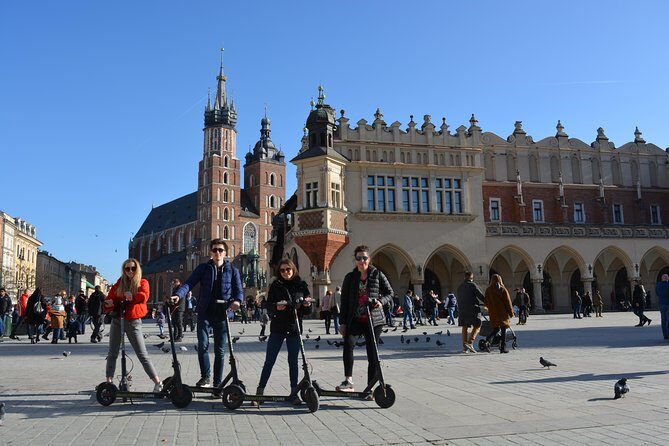
This tour works because it uses a scooter to compress distance, then uses quick stops to deliver context. You don’t get stuck for long at every corner, and you also don’t get hit with a nonstop lecture. The guide uses each stop to explain what you’re seeing and why it mattered.
In plain terms, it’s like this: you move fast enough to feel momentum, but you stop long enough to actually connect history and scenery. A few of the stops are brief, so you’ll want to bring curiosity and be ready to take in a lot at a steady pace.
Barbican: How Krakow Protected Itself
Your first major stop is the Kraków Barbican. This is where you learn how Krakow was protected—then how the city changed over time, including what happened during and after the partition of Poland.
Why this stop is a good opener: it frames the entire journey. Once you understand the defensive mindset of the city, the later wall fragments and ghetto-area remnants don’t feel random. They feel like parts of the same story, stretching across centuries.
The stop here is about 15 minutes, so it’s enough for a clear picture without dragging.
St. Florian’s Gate: A Wall Fragment With a Message
Next comes St. Florian’s Gate, described as the last remaining fragment of Krakow’s wall. The guide walks you through what happened to the wall and what you can find on the inside.
This stop works especially well on a scooter because you see the gate in the context of where the streets are today. You get a sense of how the medieval city edges still shape modern movement—without needing to trace it on your own.
Time here is short, around 5 minutes, so listen closely and look around at the surroundings. That’s where the meaning shows up.
Collegium Maius and Planty Park: Old University Energy
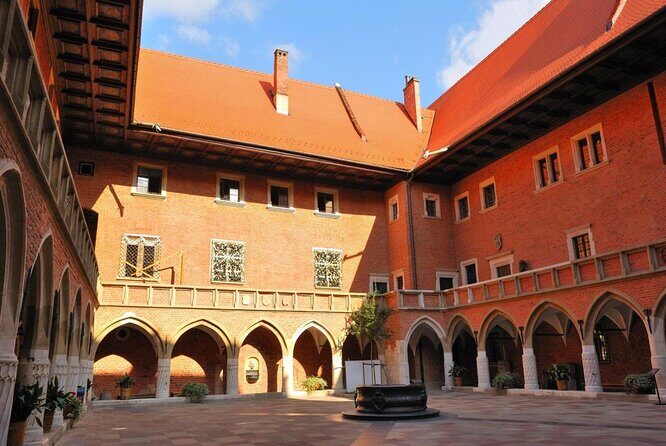
At the Muzeum Uniwersytetu Jagiellonskiego Collegium Maius, you’ll roll toward Poland’s oldest university. Before you even arrive, you ride along Planty Park, the ring of green space around the Old Town that locals love.
Even if you’re not a university-history person, Planty Park is a key transition. It’s one of those places that turns a heavy historical day into something livable. And Collegium Maius gives you a strong anchor for the intellectual side of Krakow, not only the fortifications and wars.
This segment is about 15 minutes, and it pairs nicely with the earlier defensive landmarks. You start seeing Krakow as more than a postcard. It’s a working city with layers.
Rynek Główny Central Square: Legends, Layout, and Local Lore
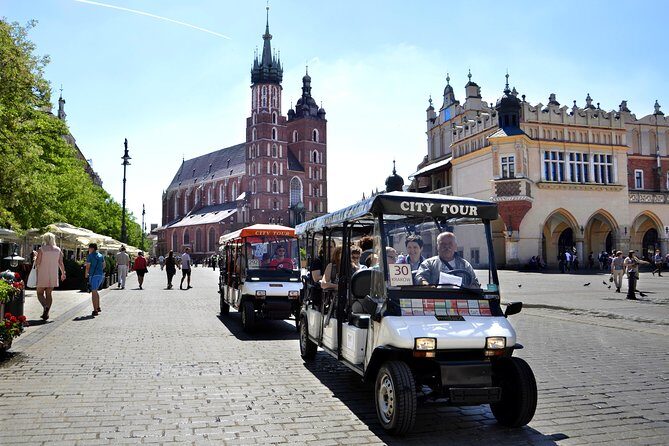
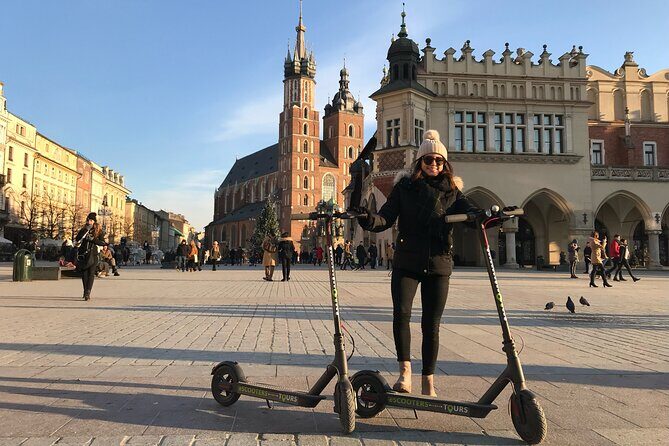
Then you’re at Krakow’s Rynek Główny, the central market square. This is where the guide explains what you need to know about the square and the sites around it, including local legends connected to St. Mary’s Church and the Cloth Hall.
This is a stop where your instincts matter. The square is big, and you’ll likely want to glance at everything. The trick is using the guide’s map in your head—so later, when you wander on your own, you understand what you’re looking at.
The stop here runs about 25 minutes, which is longer than many. Use that time to pick one or two details to remember: a façade element, a tower view, or the way the Cloth Hall sits against the square flow.
St. Peter and St. Paul: A Church Stop That Doesn’t Feel Like a Checkbox
Next is the Church of St. Peter and St. Paul. This stop is pitched as the guide’s favorite church in Krakow. The tour includes a focused explanation of what you’re seeing there.
Why I think this works: a church stop can easily become a quick photo moment. Here, it’s framed as part of the tour’s storytelling. You’re not just asked to look up at a building; you’re given reasons to notice.
The stop is around 10 minutes, so don’t expect long museum-style detail. Think of it as a narrative spotlight.
Wawel Royal Castle Viewpoint by the Vistula
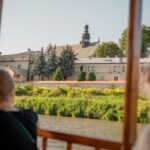
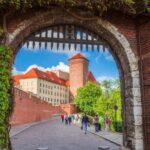
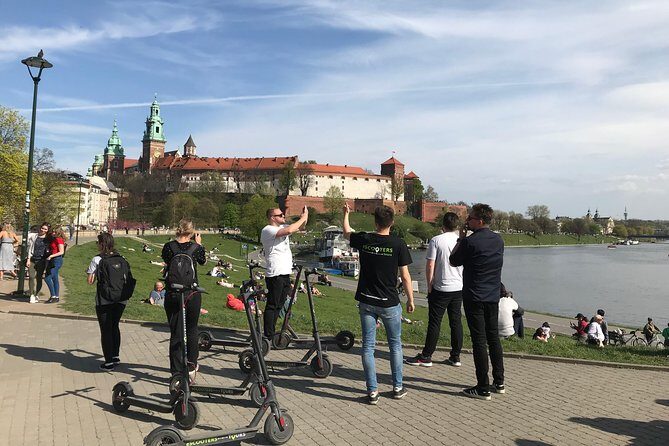
One of the most rewarding moments comes when you reach a viewpoint by the Vistula (Wisła) river. From there, you get a wonder view of Wawel Royal Castle. The guide talks about the kings and queens of Poland and more.
Wawel is one of those places that can look impressive from a distance but feel personal when you understand the people and power behind it. That viewpoint helps. From the river angle, the castle sits in a way that feels both monumental and grounded.
Time here is about 15 minutes, which is enough for the story and the view without turning it into a long stop you regret later.
Wawel Dragon: Legend You Can Spot Instantly
Then it’s the Monument of the Wawel Dragon. This is where you find out about Krakow’s beloved dragon legend. It’s also a natural pause for energy. The statue is easy to spot and the story is fun in a way that gets even adults smiling.
This stop is about 10 minutes. You don’t need more than that for a legend-based checkpoint, and you’ll probably want to get your photos before the flow moves.
Father Bernatek Footbridge and the Ghetto Story
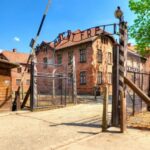
The tour crosses at the Father Bernatek Footbridge, connecting Kazimierz to Podgorze. This is a serious stop. During the war, the bridge area was transformed into a ghetto for Jews.
Here’s what makes it impactful: you see the physical geography of the city while the guide explains what that geography meant during a brutal time. It’s not just facts on a plaque; it’s a sense of location.
The stop is about 10 minutes, so the guide’s pacing matters. Listen for how the bridge connects to the rest of the ghetto-area stops later in the day.
Krakus Mound: A Real Viewpoint Break
Next you ride up to Krakus Mound, one of four mounds in Krakow. The tour calls this one of the favorite viewpoints and gives you the chance to see the city from above.
A mound stop is a strategic reset. You get a different angle and a chance to catch your breath—useful when you’ve been moving continuously on a scooter.
Time here is about 20 minutes, giving you enough slack for the view and the explanation. Just be ready for a bit of uphill riding. Your scooter will handle it, but it’s still a physical moment in the day.
Plac Bohaterów Getta and the WWII Details
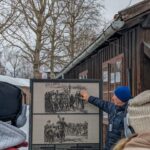
At Plac Bohaterów Getta, you learn what World War II looked like for the Jewish community in Krakow and what happened in the ghetto. The guide also covers the heroes connected with the area and explains the meaning of the statues of chairs.
This is one of the stops where the guide’s storytelling is doing a lot of work. Memorials like this can feel abstract unless someone helps you decode the design choices. The chairs are a detail you’ll likely remember later, because it’s unusual.
Time here is around 15 minutes. It’s long enough to be meaningful, short enough to keep the scooter route moving.
Remains of the Ghetto Wall: Seeing What Survived
Then you visit the remains of the ghetto wall, one of the last fragments that surrounded the area in Podgorze.
This stop is about 10 minutes, and it’s the kind of moment where you might automatically slow down and look. You’re not touring a full reconstruction; you’re seeing survival. That makes it weighty.
If you’re someone who prefers to get history in context rather than in a museum room, these wall fragments are a strong way to do it.
Schindler’s Enamel Factory Area: The War-Time Thread Continues
The tour also includes a stop connected to Oskar Schindler’s Enamel Factory, with an explanation of what war-time life looked like in Poland and how Schindler’s story fits into that landscape.
This part is designed to connect the ghetto story to broader wartime realities. You walk away with a clearer chain of cause and effect instead of isolated facts.
The time allocation here isn’t spelled out in the same way as every other segment, but expect it to be guided and focused.
Old Synagogue: The Before-War Community
Next is the Old Synagogue, where you learn about the thriving Jewish community before the war. The tour also notes that this synagogue is the oldest in Krakow.
This stop adds balance. After memorial and ghetto segments, it’s valuable to hear about what existed before the destruction. It helps the history feel human, not only tragic.
Time is about 15 minutes, so again, it’s not a long sit-down. It’s a guided framework to help you place the synagogue in the larger story.
Kazimierz Market Square and Zapiekanki Options
Finally, you swing into Kazimierz and the Market Square, described as a place to meet locals. You’re encouraged to try Poland’s fast food, zapiekanki.
Important note: the tour includes a snack earlier (the obwarzanek). Zapiekanki at the market is presented as something you’ll want to eat while you’re there, but you shouldn’t assume it’s included. Treat it as your dinner starter or late lunch plan.
This stop is about 15 minutes, which is perfect for a quick meal decision after the history-heavy parts of the tour.
Price and Value: Why This Costs What It Costs
At $69.32 per person for roughly 3 hours, you’re paying for more than a guide. You’re paying for scooter use, a helmet, warm gloves when needed, and a snack. You’re also paying for time-saving logistics: you cover a lot of central Krakow efficiently without walking every block.
Compared with a typical walking tour price, the value here often comes from two places:
- Time and distance: the scooter lets you see more areas in the same half-day window.
- Included gear: you don’t have to rent equipment or hunt for a helmet.
If your Krakow schedule is tight, this is the kind of tour that can feel like a shortcut to the best parts of the city—without rushing yourself to keep up with traffic-heavy buses.
Who This Tour Fits Best (and Who Might Want Another Option)
This is a great match if you:
- want to see many key sights in one morning or early afternoon
- enjoy history that’s told with location context, not just in a lecture hall
- like moving around and staying active, even if it’s not a hike
It’s also a solid choice for first-time visitors who want a base map of where everything is. One recurring theme from experiences with this tour is how much it helps people feel confident navigating Krakow afterward—especially because the guide’s route covers major neighborhoods.
For anyone who hates busy streets or has trouble balancing on scooters, you might want to think twice. And again, because it requires good weather, plan for a backup mindset.
What the Best Guides Add to Your Day
The quality of the tour is tightly linked to the guide, and the names you’ll see in real life matter. Guides like Sabina and Dominik are described as energetic storytellers who connect sights with meaning. One guide, Dominik, is described as Polish with perfect English thanks to growing up in the UK, which is exactly the kind of clarity you want when the history is heavy.
A practical bonus: guides give food and visit recommendations. In one case, the guide texted after the tour with suggestions, which is helpful when you’re trying to plan your remaining hours in the city.
It’s not just facts. It’s the way the guide adds next steps.
Rain, Rebooking, and Staying Flexible
Krakow weather can be stubborn. If your day looks gray, don’t panic, but do stay flexible. There’s evidence the operator can work around rain by fitting you in when conditions improve. That flexibility is part of why I’d avoid booking this tour too late in your trip.
If you only have one half-day window in Krakow, try to schedule this earlier so you still have time to adjust if the weather changes.
Should You Book the Electric Scooter Tour in Krakow?
If you want a fast, guided way to see Krakow’s highlights—Old Town sights, Wawel viewpoints, plus WWII-era locations tied to ghetto history—this tour is a strong pick. You get scooter comfort from the start with helmets, you’re helped with a practice ride, and you end up with a mental map of the city that’s hard to build from walking alone.
I’d especially recommend booking early, since it’s commonly booked ahead (often about three weeks in advance on average). And if you’re traveling with a group that likes mixing fun with story, this private format makes it easier to ask questions and keep pace.
Just go in knowing the deal: it’s an active half-day with short guided stops, not a slow museum day. If that fits your style, you’ll likely come away with Krakow feeling both seen and understood.
FAQ
How long is the electric scooter tour in Krakow?
It lasts about 3 hours on average.
What is the meeting point for the tour?
The tour starts at Librowszczyzna 4, 31-030 Kraków, Poland, and it ends back at the same meeting point.
What time does the tour start?
The start time listed is 10:30 am.
What is the price per person?
The price is $69.32 per person.
What’s included with the scooter rental?
Helmet and scooter rental are included, along with warm gloves for colder days and a free obwarzanek snack.
Do I need to bring equipment?
No. You don’t need to bring equipment for the tour since helmet and scooter rental are provided.
Is the tour offered in English?
Yes, the tour is offered in English.
What is the minimum age?
The minimum age is 12 years old.
Is this tour private?
Yes. Only your group participates, so it’s a private tour/activity.
What weather does the tour require?
The experience requires good weather. If it’s canceled due to poor weather, you’ll be offered a different date or a full refund.